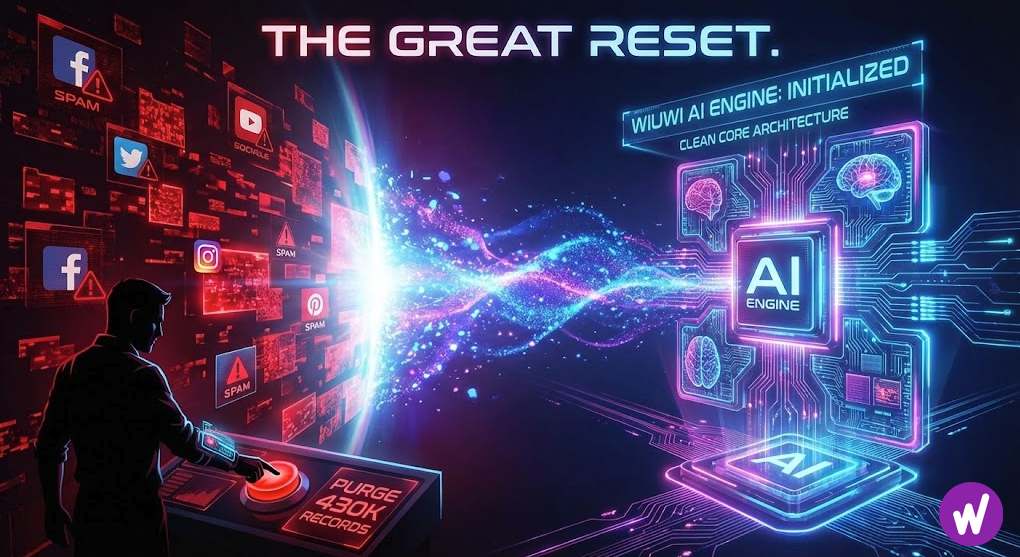
I deleted 430,000 user-generated posts from a live platform that was still growing organically.
Most founders would call me crazy.
Imagine you have a platform running on auto-pilot. It’s growing. Organically. You wake up every morning to find 70+ new users signing up without spending a dime on ads. You have a database filled with nearly 50,000 registered users.
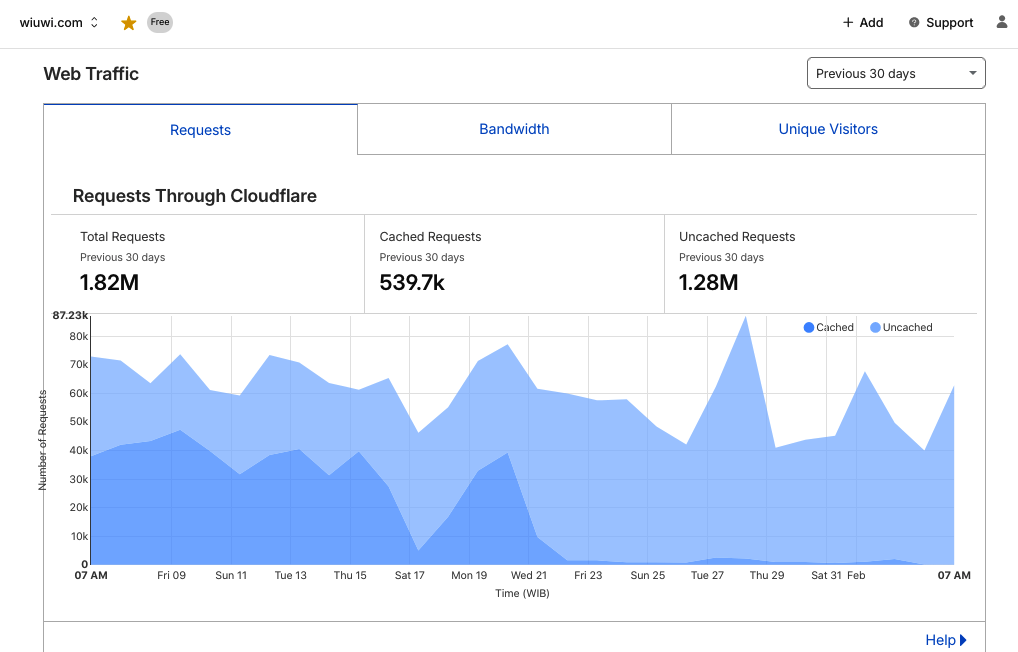
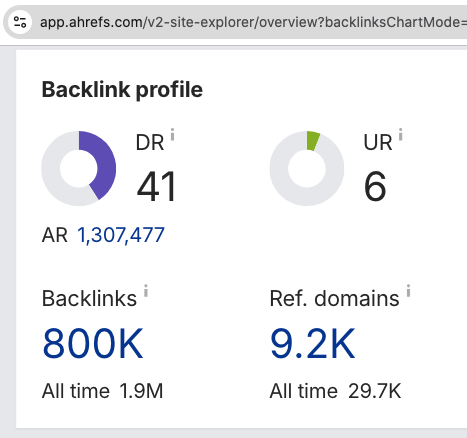
The traffic log is screaming: 1.82 Million requests per month. The SEO metrics are beautiful: Domain Rating (DR) 41, DA 36, PA 46.
The platform was reaching the stage where monetization paths were becoming realistic. The traffic was there. The users were there. It looked like a success story.
So, why did I decide to burn it all down?
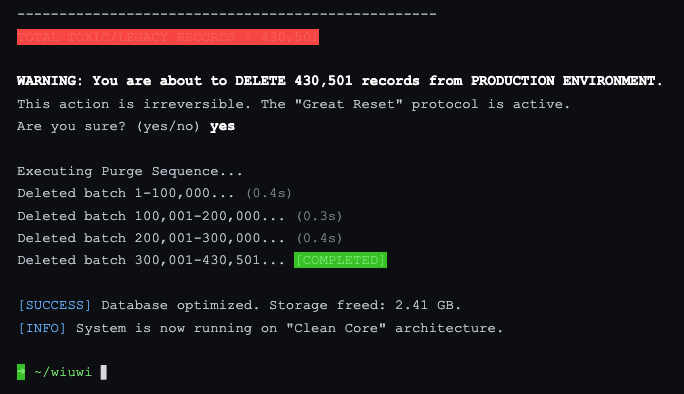
Why did I execute a command that wiped out nearly half a million rows of data to reset Wiuwi.com from scratch?
Here is the deep dive into the most difficult—yet strategic—engineering decision of my career.
The Trap of “Vanity Metrics”
Wiuwi started as a social network platform. It worked too well. The organic traffic was addictive. But when I looked closer at the data quality, the reality hit me.
A significant portion of those “users” weren’t there to build a community. They were there for SEO backlinks. Or worse.
As the platform grew, I started noticing the dark pattern of User-Generated Content (UGC). While many posts were legitimate, the “noise” was increasing. I saw an influx of gambling promotions, adult content, and illegal substance transactions.
I learned a hard lesson that day: Scale without quality is not growth — it is entropy.
I refused to let my platform become part of the internet’s problem. I wasn’t running a social network anymore; I was running a massive moderation queue.
The Engineering Response: Automated Defense
I’m an engineer, not a content moderator. I don’t solve problems by hiring an army of admins; I solve them with code.
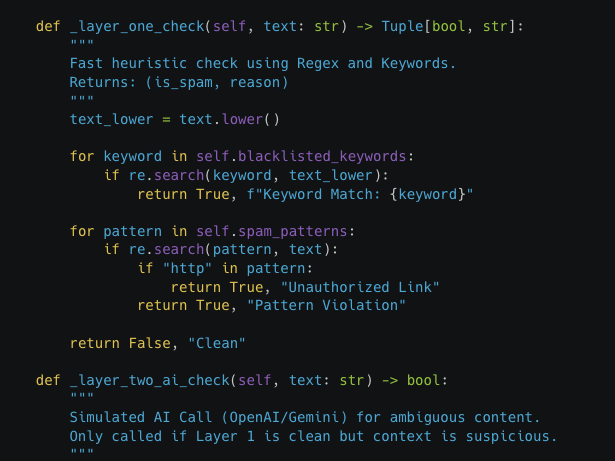
I designed and executed a Hybrid Filtration System independently to fight back:
-
Layer 1: The Rule-Based Gatekeeper (Python) I wrote scripts to detect specific keywords, patterns, and regex anomalies. This handled the “low-hanging fruit”—the obvious spam. It was fast and cheap.
-
Layer 2: The AI Judge (LLM) For content that passed Layer 1 (the subtle ones), I integrated an AI pipeline. But here’s the catch: AI is expensive at scale. You can’t just feed 400k posts into GPT-4 without burning your wallet.
So, I architected a cost-optimized workflow. Only “suspicious but ambiguous” content was sent to the AI. This dramatically improved processing speed and reduced API costs by 90% while maintaining high accuracy.
It worked. I blocked thousands of illegal posts. But it forced me to ask a bigger question.
The Strategic Pivot: From “Maintenance” to “Innovation”
I looked at Wiuwi and asked myself: “Do I want to be the CEO of a spam-fighting social network? Or do I want to be an Architect of the future?”
Maintaining a legacy social network consumes resources. It forces you to look backward (cleaning up messes) instead of forward (building new tech).
I realized Wiuwi’s true asset was never its content.
It was the infrastructure, the traffic intelligence, and the scalable AI-ready architecture behind it.
So, I made the call. The Great Reset.
Deleting those records meant deleting years of organic growth history. It wasn’t just a technical action. It was a leadership decision.
Why This Matters
I deleted the legacy database not because I failed, but because I prioritized long-term architecture over short-term vanity metrics.
This entire transition—from the moderation system to the architectural pivot—was designed and executed independently.
By pivoting Wiuwi into a High-Performance AI Engineering Lab, I am demonstrating exactly what I bring to the table:
-
Integrity over Metrics: I will not inflate numbers with toxic data.
-
Scalability Mindset: I build systems that handle millions of requests, but I also know when to optimize for cost.
-
Growth Strategy: I am especially effective in companies that are transitioning from early traction to scalable infrastructure.
The New Era
Wiuwi is no longer just a platform.
It is my public engineering laboratory—where ideas are tested under real traffic, real constraints, and real business pressure.
And this reset is only the beginning.